Research guide · Feasibility
What should an AI feasibility study establish?
A useful study explains whether an idea merits an experiment, what that experiment must test and which uncertainties remain.
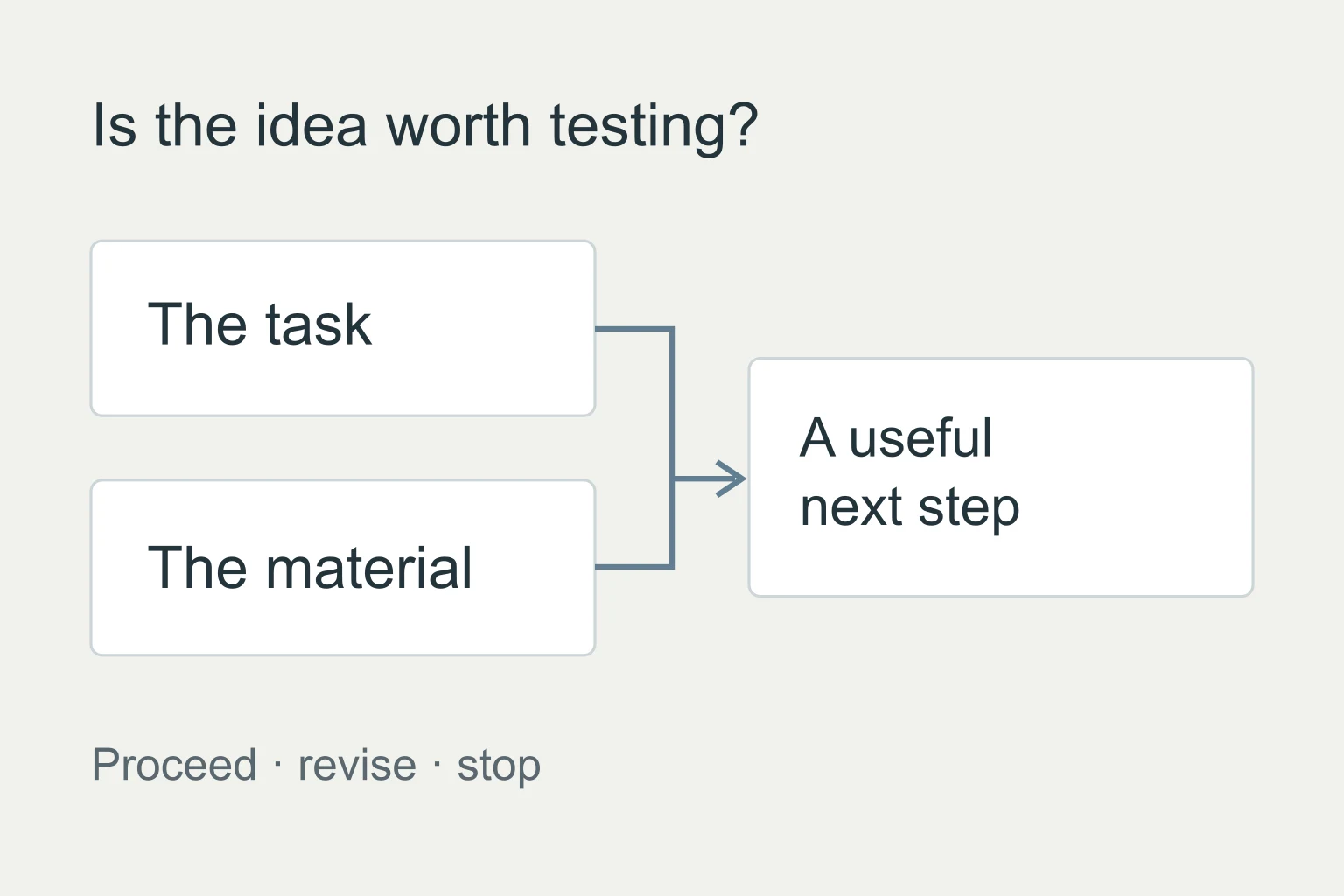
Begin with the decision the study will inform.
An AI feasibility study is a structured examination of whether a defined task is plausible under specified data, technical and operational constraints. It should produce a reasoned next step, rather than a general statement that AI has potential.
Write the decision in a sentence. For example: “Should we invest in a prototype that answers internal procedure questions from an approved document collection?” This gives the study a boundary. It also leaves room for a narrower recommendation if the evidence does not support the original idea.
Then describe the intended task. Who asks the question? Which information may be used? What form should the answer take? Who checks it? A task that sounds simple at headline level may contain several separate uncertainties: finding a relevant passage, interpreting an exception and recognising that no answer is available.
Context matters in established risk frameworks too. The NIST AI RMF Core includes defining the specific tasks a system will support and selecting relevant measurement approaches. The method below is our proposed practical approach, not a NIST certification process.
Examine the material before assuming the method.
List the data or documents the proposed system would need. Ask whether they exist, whether they can be accessed for research and whether they represent the intended use. A collection of clean examples may conceal the difficult cases that dominate real work.
Inspect a permitted sample. Look for missing fields, conflicting versions, scanned text, inconsistent terminology and gaps in the source material. These observations can change the question being tested. If the source cannot answer an important class of questions, changing the model may not solve the problem.
Record the limitations of the sample. Synthetic examples may help test a technical path, but they cannot establish how the approach behaves on material that has not been represented. Similarly, an expert's hand-picked examples may be useful for discovery without being suitable as the final test set.
Compare a simpler alternative
Define the current baseline: manual review, ordinary search, a fixed rule or a simpler statistical method. An AI approach needs to offer a relevant advantage under the constraints. The appropriate outcome may be that better document organisation would address more of the problem than a model experiment.
Turn uncertainty into an experiment brief.
Choose the assumption whose failure would most change the investment decision. For a source-supported answer system, that might be whether the relevant evidence can be found reliably enough to make answer generation worth testing. For a classification task, it might be whether domain reviewers can agree on the intended labels.
Define the proposed inputs, the baseline, the candidate approach and the assessment method. Identify ordinary cases, difficult cases and cases where the right answer is “I do not know”. Decide which examples will be reserved for assessment rather than repeatedly used to improve the system.
| Question | Useful evidence |
|---|---|
| Is the task well defined? | Input and output examples, reviewer guidance and known exceptions. |
| Is the data suitable? | Permitted samples, coverage notes and source-quality findings. |
| Is the method plausible? | Relevant technical evidence and a clearly limited proposed test. |
| Would success be useful? | A decision owner, a baseline and task-specific acceptance criteria. |
Set stop criteria as well as success criteria. If no permitted data can represent the task, or reviewers cannot define acceptable output, a prototype may be premature. Resolving those conditions can become the next step.
Read the recommendation with its limits.
The final brief should separate what was observed, what was inferred and what remains a proposal. It should explain the recommendation, the assumptions behind it and the evidence that would change it. A go decision is usually a recommendation for a defined next experiment, not a declaration of production readiness.
The NIST AI Risk Management Framework is voluntary guidance intended to support the consideration of trustworthiness throughout AI design, development, use and evaluation. A feasibility study can contribute information to that wider process; it does not complete it.
For a scoped investigation, see AI Research & Feasibility. Once the question is ready to test, use our guide to proof-of-concept success criteria to define what meaningful progress would look like.
See a small worked example.
Inspect the source, illustrative answers and review judgments in our answer-evaluation example. The downloadable worksheet shows a possible recording format; it is not a client result or a model benchmark.